Imagine you’re running a store that gets thousands of walk-in customers every day, but only a few end up buying something. Now, instead of trying to bring in more people, what if you could simply convert more of the ones who are already there? That, in essence, is what Conversion Rate Optimization (CRO) does for your website.
CRO is the systematic process of increasing the percentage of website visitors who take a desired action—whether that’s making a purchase, subscribing to a newsletter, booking a call, or even downloading a lead magnet. Instead of throwing money at ad platforms and waiting for a miracle, CRO helps you squeeze every bit of value out of your existing traffic.
Let’s say you get 10,000 visitors a month, and only 2% convert—that’s 200 conversions. But if you improve that to just 4%, you’ve doubled your results without spending an extra dime on traffic. That’s the magic of CRO.
And it’s not just about tactics like changing button colors or tweaking headlines. Real CRO is rooted in understanding your users—what they want, what’s stopping them, and how you can make it ridiculously easy for them to say “yes” to your offer.
It’s 2025, and if you’re still treating CRO as a “nice-to-have,” you’re already behind. The digital landscape has changed drastically:
Relying solely on traffic to drive revenue is like filling a leaky bucket. You need to fix the holes before pouring in more water. CRO is the patch—and sometimes the upgrade—that transforms your website from a static billboard into a 24/7 sales machine.
According to the latest insights from our CRO Guide, High-performing businesses are treating CRO not as a side hustle but as a core growth approach best supported by robust digital marketing services.
That’s why we’ve created a powerful, easy-to-follow document packed with real-world examples, checklists, and frameworks to help you get serious results fast.
Ready to stop guessing and start converting? We’ve prepared a detailed Conversion Rate Optimization (CRO) Guide that walks you through the exact steps high-growth companies use to turn browsers into buyers. This guide includes:
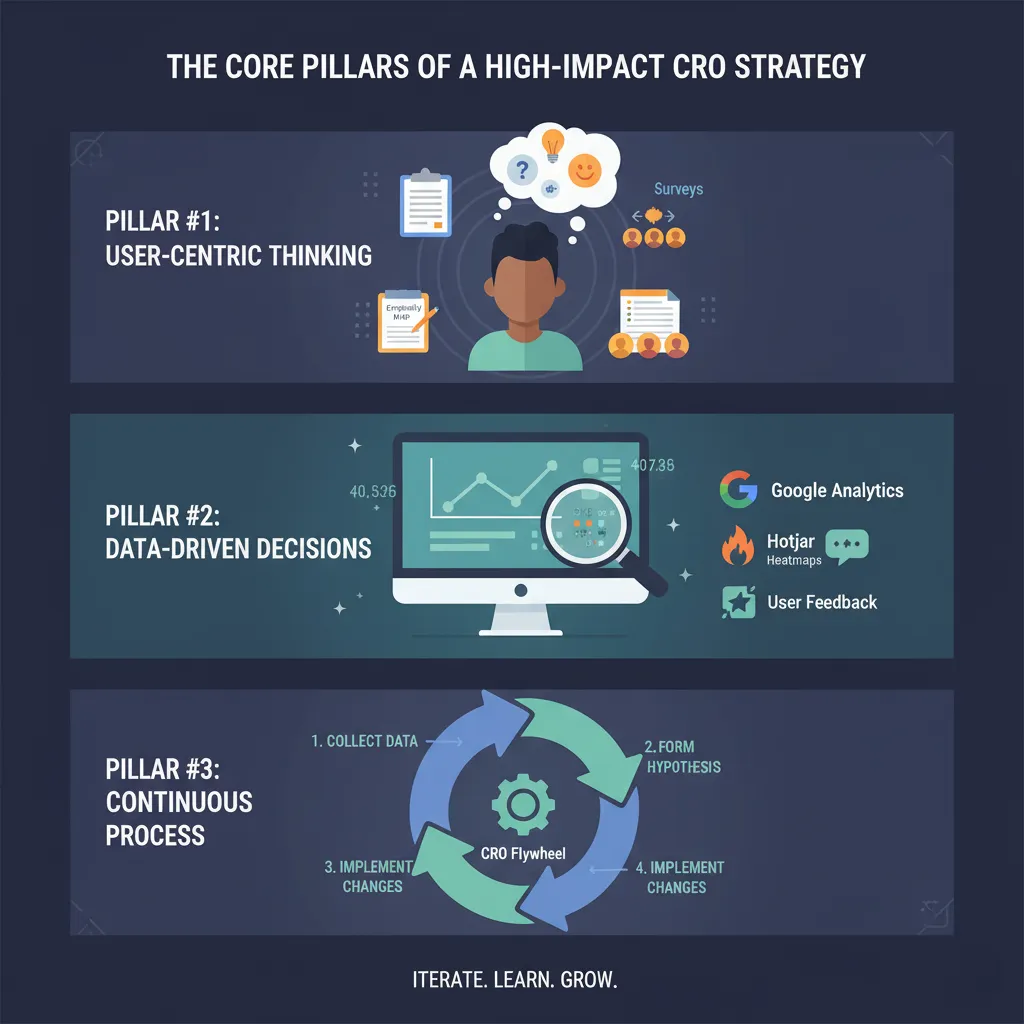
At the heart of CRO is empathy. If you don’t understand your users—their needs, motivations, fears, and frustrations—you’re not optimizing; you’re just guessing. CRO begins with a simple but powerful shift in mindset: stop designing for you, start designing for them.
Think of your website like a guided tour. Is the path clear? Are the signs helpful? Does the experience match what your visitors expect?
Here’s what user-centric CRO looks like:
This principle helps you avoid classic mistakes like cluttered designs, complex forms, or jargon-heavy copy that might make sense to you—but confuse your users.
Bottom line: when you build around your users, conversions happen almost naturally.
Gut feelings have their place in business—but not in CRO. Every decision, from the headline on your homepage to the layout of your checkout form, should be backed by real data.
This doesn’t mean you need a degree in statistics. It means using simple tools like:
And then acting on that data with confidence.
What works for one site might tank another. The only way to know is to test, measure, and iterate. And the more you embrace data, the faster you’ll spot opportunities for improvement.
This isn’t a one-and-done thing. Think of CRO as an ongoing relationship with your website and your audience. Trends evolve. Competitors catch up. What worked yesterday might underperform tomorrow.
Smart brands bake CRO into their culture. They test weekly. They learn from every user interaction. They don’t chase hacks—they build systems.
To win in 2025 and beyond, you must treat CRO like brushing your teeth. Routine. Necessary. Non-negotiable.
Before you run your first test, tweak a CTA, or redesign a form, pause and ask: what are we optimizing for? CRO without clear goals is like navigating without a map.
Macro conversions are the primary business goals. Think purchases, demo bookings, trial signups, or contact form submissions. These are the big wins that drive revenue and growth.
Micro conversions, on the other hand, are the smaller, supporting steps that lead people toward those macro goals. Things like:
Tracking both types is essential. Why? Because micro conversions offer early signals of friction. If people are adding to cart but not buying, you have a checkout issue. If they never add to cart, your product or landing page messaging may be weak.
Use tools like Google Analytics, Mixpanel, or Amplitude to set up conversion tracking. Define every key action on your site—no matter how small—so you can map how users flow through your funnel.
When you have clarity on your conversions, you’ll make smarter decisions faster. You’ll also uncover which levers move the needle most.
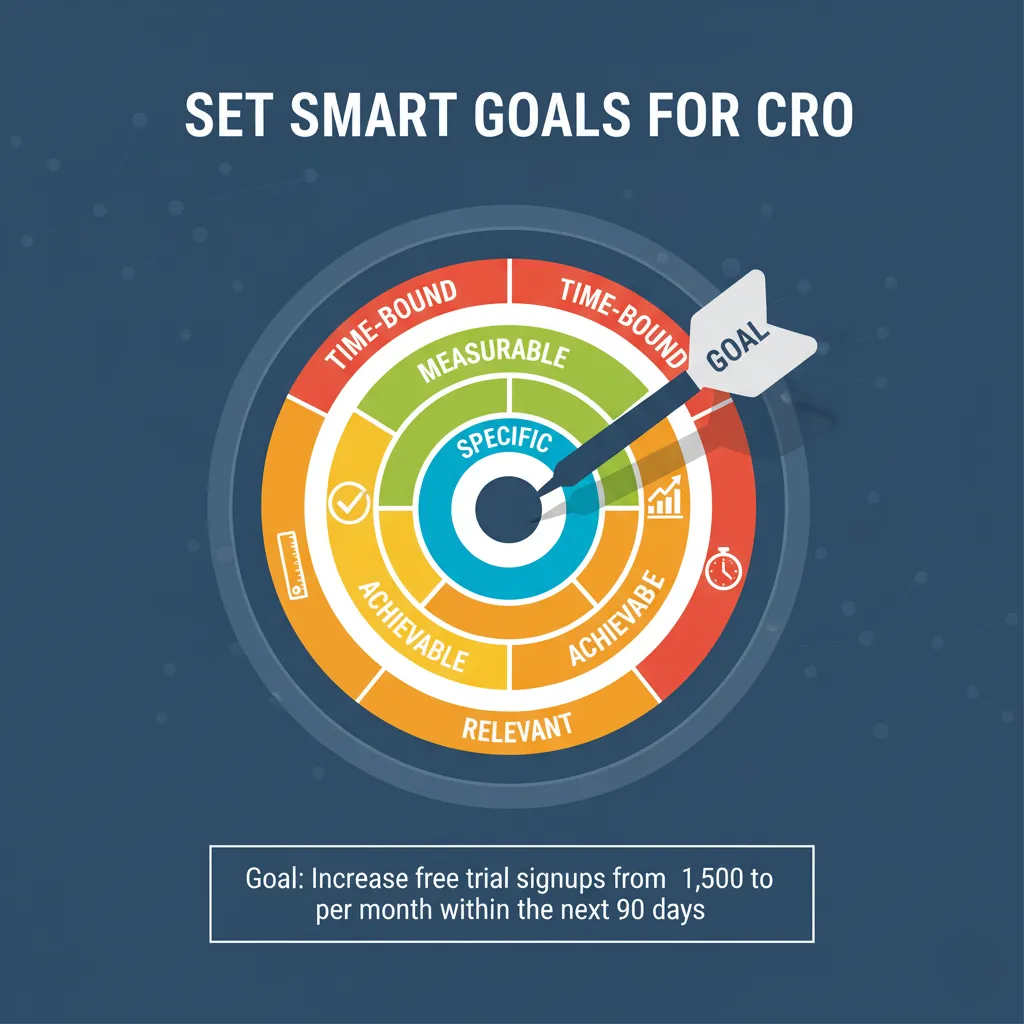
Every optimization effort should ladder up to a clear goal—and not a vague one like “improve conversions.” You need SMART goals:
Here’s a weak goal:
“Improve trial signups.”
Here’s a strong SMART goal:
“Increase free trial signups from 1,000 to 1,500 per month within the next 90 days.”
By grounding your strategy in SMART goals, you give your team a clear finish line and the ability to measure progress objectively. This eliminates guesswork and helps you stay focused, even when dozens of optimization ideas are flying around.
SMART goals also make testing more strategic. You know why you’re testing something and what outcome you expect. That clarity creates momentum.
Would you start improving a car without knowing if it’s even broken? Of course not. That’s why benchmarking your current performance is a CRO essential.
Use data to establish a baseline:
This snapshot gives you a before/after view once you begin optimization.
But don’t stop there.
You also need to map your customer journey—from awareness to decision:
Visualize this journey. Identify where users fall off. Are they bouncing at the pricing page? Hesitating at the checkout? Abandoning the contact form?
Tools like Hotjar, Microsoft Clarity, and user session recordings are goldmines here. They show you the real journey, not the one you think they take.
And remember: CRO doesn’t fix everything at once. It fixes what matters most first. That’s why understanding the customer journey is so critical—it tells you where the problem starts and what’s costing you the most money.
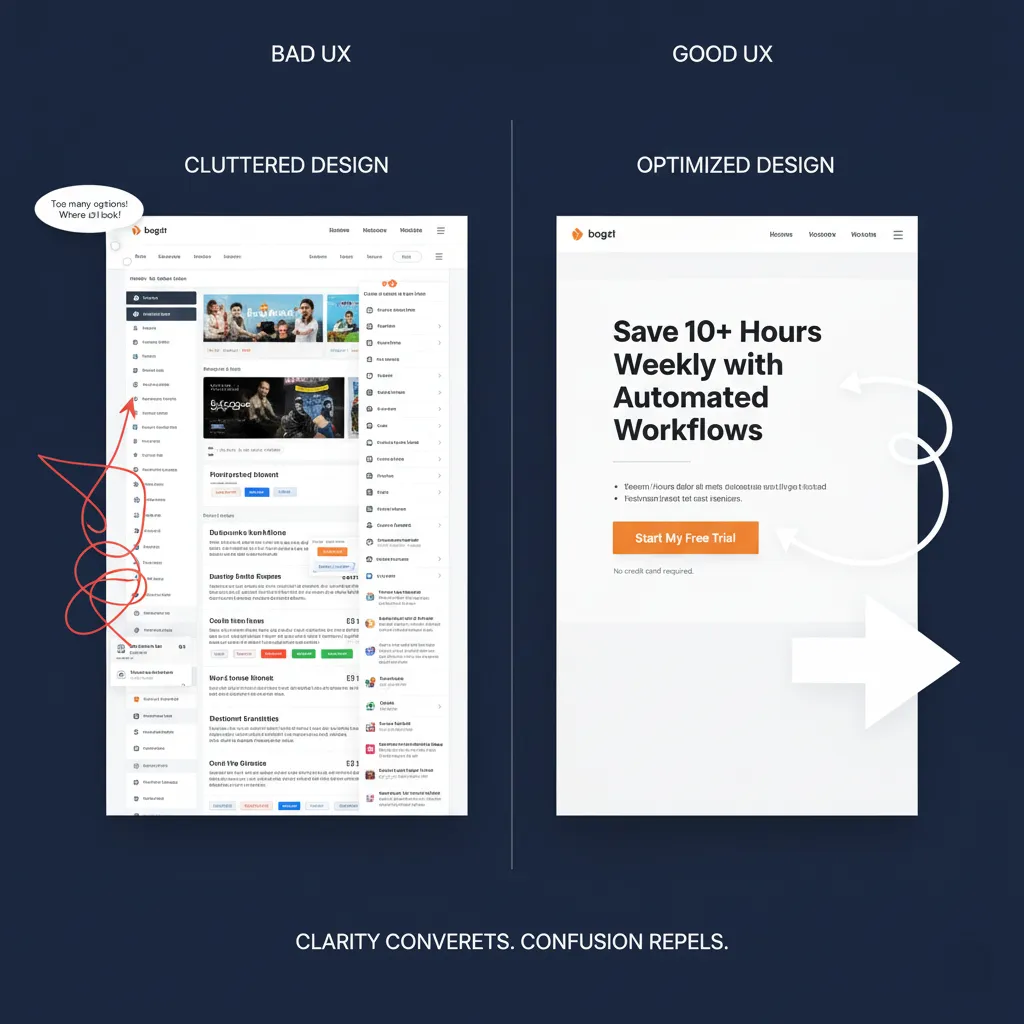
You have less than 7 seconds to make an impression. If your homepage is cluttered, slow, or confusing—people bounce. Simple as that.
Great design isn’t about being flashy — it’s about guiding attention. That’s where visual hierarchy comes in. Your most important message should be the first thing they see. Your CTA should pop without feeling pushy. Your layout should lead the eye, not fight it.
That’s why smart marketers complement CRO with UI/UX design services that convert.
Here’s how to nail it:
Look at Dropbox’s homepage redesign. They stripped out clutter, highlighted just one action (sign up), and increased signups across the board. That’s the power of design with a purpose.
And don’t forget the “gut test.” Open your site and ask: would someone know exactly what I offer in 5 seconds? If not, it’s time to optimize.
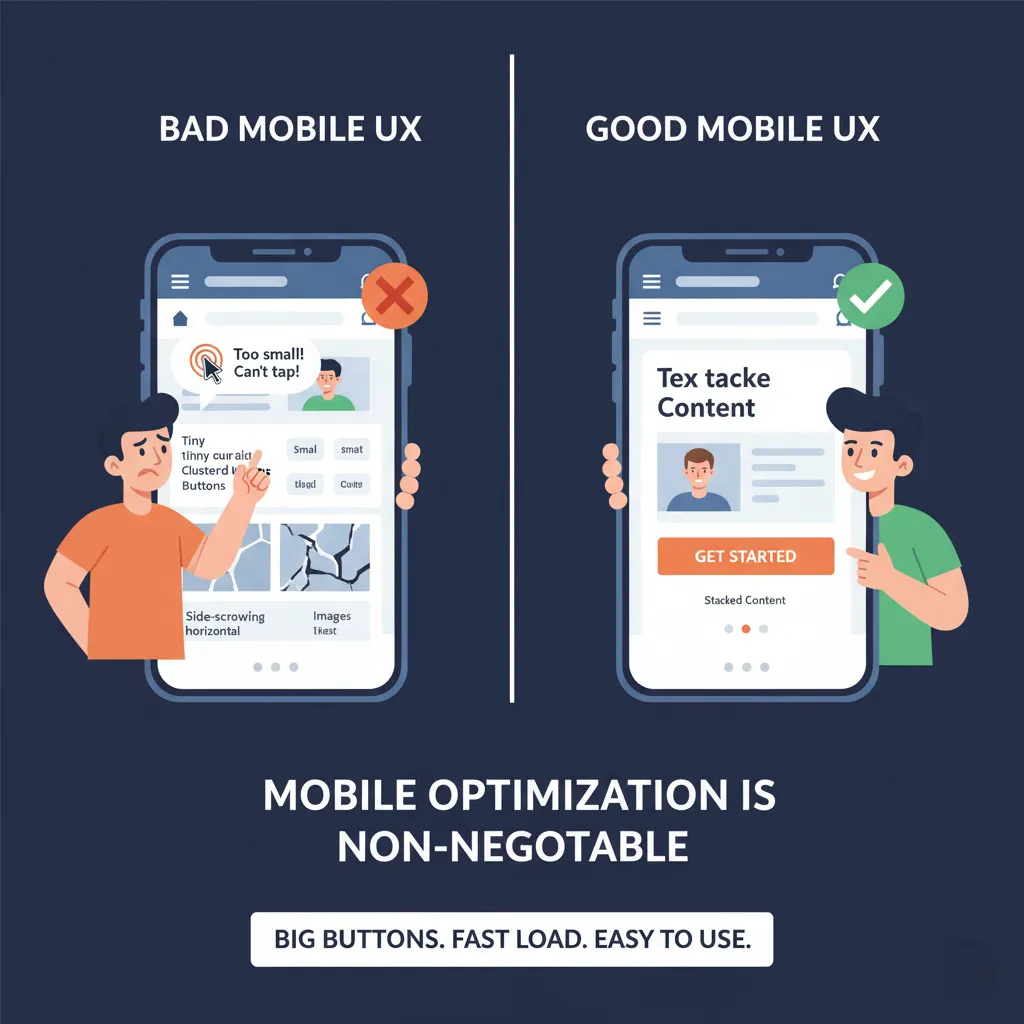
More than half of your visitors are on their phones. Yet many sites still look—and behave—like they were built for desktops in 2012.
If users have to pinch, zoom, scroll sideways, or tap tiny buttons, they’ll leave. Fast.
Your CRO wins will vanish if your mobile experience sucks.
Here’s what mobile-first design looks like:
Run your site through Google’s Mobile-Friendly Test. Watch actual mobile user sessions with Hotjar. And always preview landing pages on multiple screen sizes before publishing.
Mobile isn’t optional anymore—it’s your primary battleground. Treat it that way.
Accessibility is more than a checkbox—it’s a conversion strategy. When your site works for everyone, you earn more trust, reduce bounce rates, and open the door to new audiences, including those with disabilities or impairments.
Start with accessibility essentials:
Beyond accessibility, trust-building elements are CRO gold. If people don’t feel safe, they won’t convert—period. This is especially true for first-time visitors and high-ticket purchases.
Place these trust signals near your CTAs:
You’re not just asking people to click—you’re asking them to trust you. Don’t make them guess if it’s safe to take the next step.
Even subtle design changes—like using friendly microcopy around forms (“We’ll never spam you”)—can reduce friction and increase trust.
Great CRO starts by making your visitors feel seen, understood, and protected. Accessibility and trust do exactly that.
To improve conversions, you need to know where things are breaking down. That’s what quantitative data gives you—the what behind user behavior.
Use platforms like:
These tools show hard numbers:
Key metrics to monitor:
This data shows you where to look—but not why things happen. For that, we turn to…
Numbers tell part of the story. To truly understand your users, you need qualitative insights—the emotions, thoughts, and frustrations behind their actions.
Here’s how to get them:
Qualitative data bridges the gap between behavior and intent. It tells you why your beautifully designed landing page might still fail.
Example: Your analytics show a 60% drop-off at checkout (quantitative). Recordings reveal users get confused by mandatory account creation (qualitative). That insight tells you what to fix: enable guest checkout.
Once you gather all that data, you’ll likely end up with a laundry list of things to fix. But here’s the secret: you can’t fix everything at once.
Enter the PIE framework—a simple way to prioritize based on:
You want to start with high-potential, high-importance, and easy-to-execute items. Example: removing two fields from a long signup form is easier and more impactful than a complete homepage redesign.
Another option is the ICE framework (Impact, Confidence, Effort).
These frameworks prevent decision paralysis. They give your team a roadmap so you’re not just reacting to every heatmap or user comment. You’re working from a plan—and that’s how CRO becomes a growth engine.
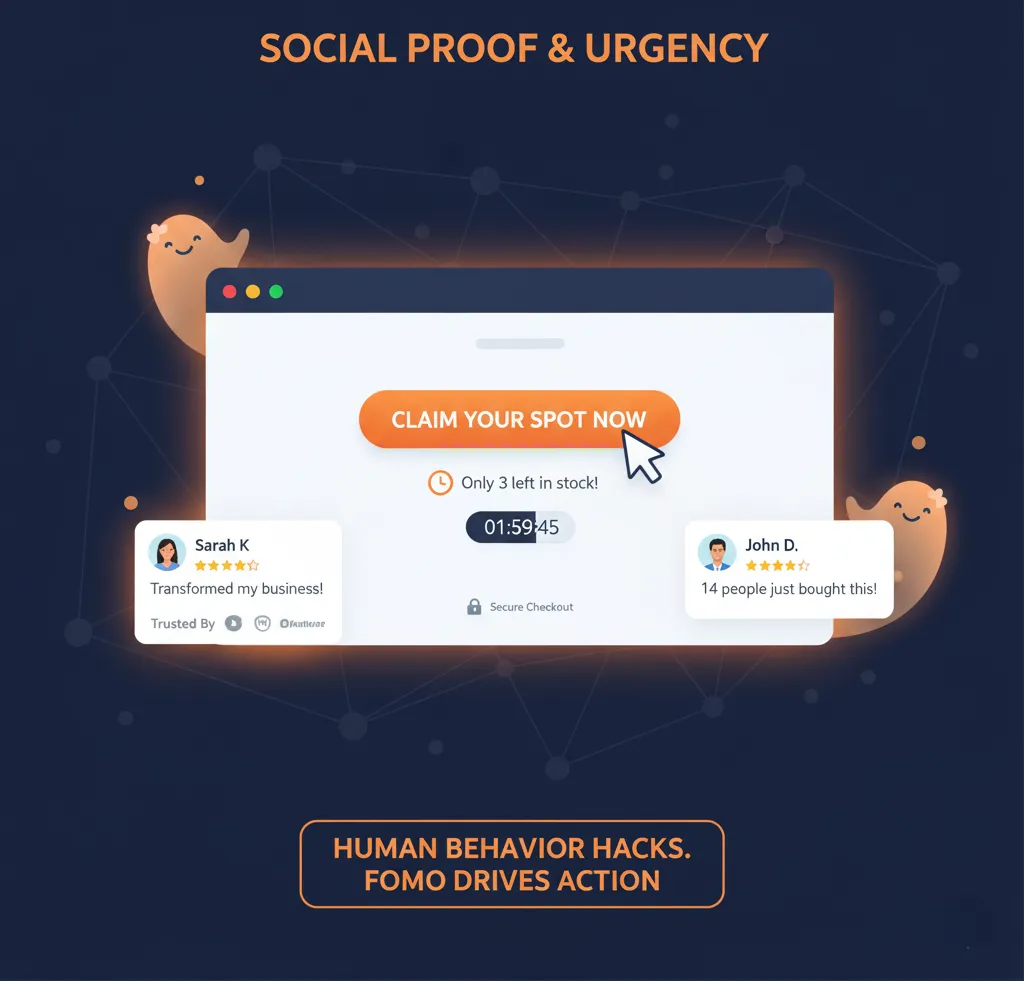
We’re social creatures. When we see others using and loving a product, we’re more likely to trust it ourselves. That’s why social proof is a core psychological driver in CRO.
Examples of effective social proof:
Social proof creates what psychologists call “herd behavior.” If others have done it—and had a good experience—it must be safe for me too.
Place social proof:
Combine that with trust signals like:
Together, they reduce friction, eliminate doubt, and nudge users toward action.
Want an instant win? Add a few trust indicators near your CTA and watch engagement improve.
We humans are funny—we hate missing out more than we love gaining something. That’s why scarcity and urgency are such powerful psychological levers in CRO.
When used ethically, these tactics can significantly boost conversions.
These tactics tap into FOMO—fear of missing out—and push users to act now instead of later (which often means never).
Just don’t fake it. Visitors are smart. If you use phony timers or false stock claims, you’ll lose trust—and conversions.
Now pair urgency with a clear value proposition and you’ve got CRO gold.
Your value prop should answer:
Weak: “Our software has automation features.”
Strong: “Save 10+ hours every week with automated workflows tailored to your business.”
Clarity converts. Clever doesn’t.
Make your value bold, obvious, and unmissable—especially above the fold.
Every potential customer has objections swirling in their head. It’s your job to address those before they kill your conversion.
Some common ones:
If you don’t answer these upfront, they’ll hesitate—and bounce.
Smart CRO-focused copywriting anticipates and handles objections proactively.
Ways to do this:
You can also use live chat or exit-intent surveys to uncover hidden objections and bake those insights into your copy.
For example:
“I’m not sure it’ll work for my industry.”
Now your new FAQ says:
“Yes, we work with over 1,000 clients in healthcare, finance, and SaaS.”
Objection-handling isn’t about being pushy. It’s about helping people feel confident, informed, and safe to take the next step.
Visitors don’t read—they scan. If your headline doesn’t hook them instantly, they’ll be gone before the page even loads fully.
Your headline is the billboard of your site. It must:
Weak headline: “We offer email marketing software.”
Strong headline: “Get 3x More Leads with Automated Email Funnels.”
Always lead with benefits. Avoid jargon. Focus on what your customer gets, not what you do.
Headline best practices:
Test different headline variations with A/B tools. Often, a small tweak can lead to a massive lift in conversions.
Your visitors don’t care about your features—they care about what your features do for them.
That’s why benefit-first copy is essential in CRO.
Let’s look at an example:
Feature-first: “Our tool integrates with over 50 platforms.”
Benefit-first: “Connect your favorite tools and automate your workflow in minutes—no dev team needed.”
See the difference?
Benefit-driven copy:
Other tips:
Want your body copy to sing? Talk to your users. Use their exact words from interviews, reviews, or chats. Real language connects—and converts.
You’ve done the hard work—attracting traffic, guiding them through your message. Don’t let it all fall apart with a weak CTA.
CTA (Call to Action) buttons should be:
You can even personalize them:
Place CTAs:
Also, test microcopy around your CTA. A line like “No credit card required” under a form can lift conversions dramatically.
Remember: your CTA is the final handshake. Make it firm, friendly, and irresistible.
CRO isn’t a guessing game. It’s a science. And A/B testing is your lab.
With A/B testing (also called split testing), you compare two versions of a webpage or element to see which one performs better. You split your traffic 50/50 and let the results tell the story.
Here’s how to run an effective A/B test:
A/B testing is great for:
What not to do:
A/B testing gives you clarity, confidence, and real results. Use it regularly, and your website will evolve into a conversion machine.
Data insights mean little if your website can’t adapt. A skilled web development company can implement A/B test variations, dynamic content, and performance tweaks without breaking the UX.”
If A/B testing is like testing two recipes with different sauces, multivariate testing is like testing multiple ingredients all at once.
With multivariate tests, you can test several combinations of changes at once—headline + image + CTA, for example. It’s faster in high-traffic environments but requires more statistical power.
Only run multivariate tests if:
Speaking of which…
Every test must start with a hypothesis.
This isn’t optional. It’s the foundation of scientific experimentation.
A good hypothesis looks like:
“If we simplify our pricing page by removing the secondary CTA, more users will proceed to checkout because it reduces decision fatigue.”
Bad hypothesis:
“Let’s try changing stuff and see what happens.”
The clearer your hypothesis, the easier it is to evaluate success.
Document each test:
Even “failed” tests offer value—they tell you what doesn’t work. That’s progress.
CRO is a loop, not a line. You don’t do it once and move on. You keep testing, learning, and refining.
Here’s the CRO Flywheel:
Each spin of the wheel makes your site stronger. Your messaging is sharper. Your funnels are smoother. Your revenue is higher.
Dropbox, Booking.com, and Amazon run hundreds—sometimes thousands—of tests every year. Why? Because they know that even 1% lifts, when compounded, lead to massive gains over time.
So don’t wait for “big ideas.” Optimize relentlessly. Improve one piece at a time. Keep spinning that wheel.
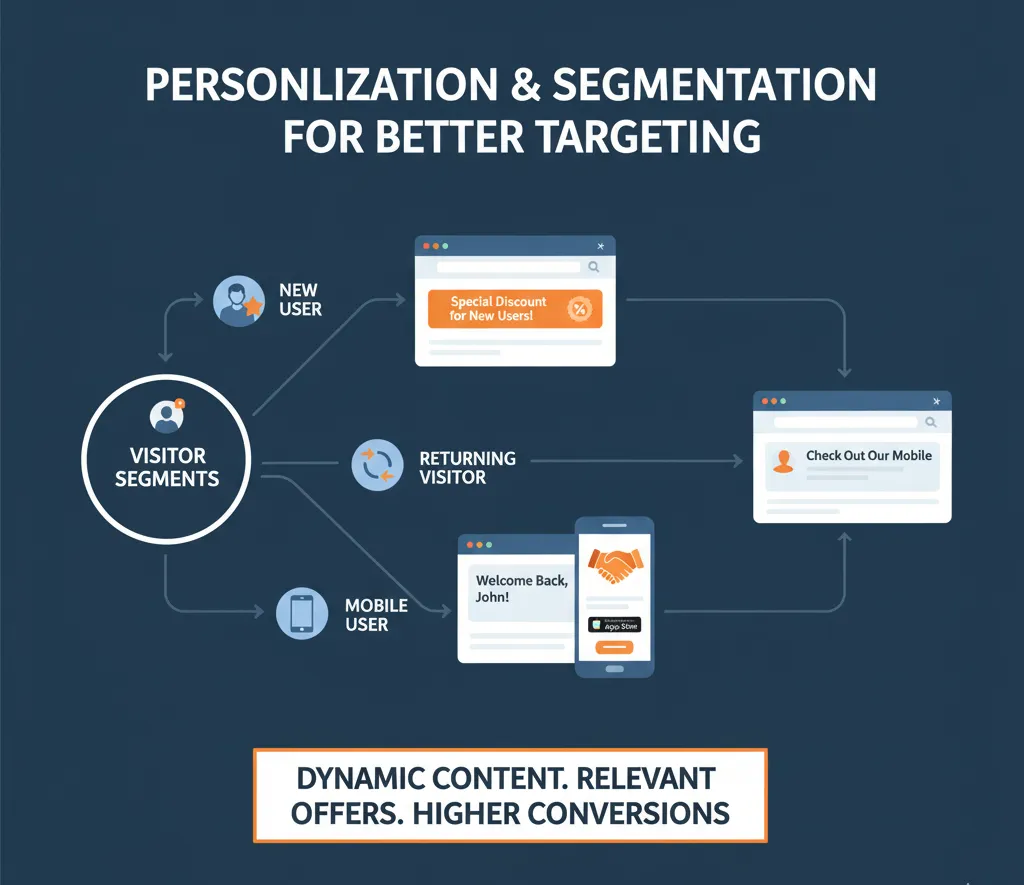
Not all visitors are created equal. Some are ready to buy. Others just got here. A blanket message won’t convert both.
That’s why segmentation is key. It means breaking your audience into meaningful groups so you can tailor your content and offers.
Easy ways to segment:
Once you segment, you can customize:
Segmentation makes users feel seen—and that builds trust.
Go deeper by tailoring your site based on what users do—not just who they are.
Examples:
Behavior-based personalization is powerful because it reflects real interest.
Tools to try:
Keep it subtle. Don’t overwhelm users. One personalized message is often more powerful than 10 generic ones.
The conversion journey doesn’t end when someone leaves your site. In fact, that’s often when it begins.
That’s where personalized follow-ups come in:
Best practices:
Personalized follow-ups don’t just increase conversions. They increase loyalty, too.
Site speed is one of the easiest—and most overlooked—ways to boost conversions instantly.
Did you know?
Just a 1-second delay in page load can drop conversions by 7%. For eCommerce, that’s the difference between profit and loss. Speed affects SEO, user experience, and trust—all major CRO factors.
Common culprits for slow speed:
Mobile speed matters even more. Most users won’t wait more than 3 seconds on a phone.
If you’re investing in traffic but haven’t optimized speed, you’re literally burning money. Fix this first—it’s the lowest-hanging fruit in CRO.
Google now uses mobile-first indexing, and over 60% of web traffic is mobile. If your mobile site frustrates users, conversions tank—even if your desktop version is perfect.
Mobile CRO checklist:
Also, track and improve your Core Web Vitals, which Google uses to measure user experience:
Improving these metrics increases both conversions and SEO rankings. It’s a double win.
Your site may look great, but if it feels off—slow, broken links, insecure forms—people won’t trust it. And trust is the silent killer of conversions.
Build technical trust by:
Also, make sure your checkout experience or lead form is frictionless—no surprise fees, no unnecessary steps, no clunky interfaces.
When your tech is tight, users feel safe. And safety is the foundation of action.
If you’re not tracking, you’re not optimizing—you’re just guessing.
Every high-performing CRO program starts with clear tracking.
Use:
Track both:
Set up goals in GA4, tag events in GTM, and monitor performance weekly.
UTMs are your best friend when it comes to attribution. Add them to links in:
Example:
?utm_source=linkedin&utm_medium=cpc&utm_campaign=cro_offerThis helps you:
Use funnel reports to analyze where users drop off. Focus on the biggest leak first—plug that hole and watch your conversions rise.
Don’t just track for the sake of tracking. Align CRO metrics with business KPIs.
Report on:
Use visuals—bar graphs, funnel charts, and heatmaps—so non-technical stakeholders get it at a glance.
CRO wins don’t just live in your dashboard—they should drive decisions across marketing, sales, and product.
CRO is not a “project.” It’s a habit.
The most successful companies treat optimization like they do sales meetings or accounting—it’s on the calendar, regularly reviewed, and taken seriously.
Steps to build a CRO habit:
CRO isn’t about perfection. It’s about progress. Small wins stack up. Big wins start from those small tweaks.
CRO isn’t just for marketers. Your whole team has valuable insights:
Create a CRO channel in Slack or Asana. Invite ideas. Share data. Celebrate wins.
The more brains you involve, the smarter your tests will be—and the faster you’ll grow.
Don’t repeat failed tests. Don’t forget your best-performing changes.
Create a central CRO log that includes:
Use tools like Notion, Airtable, or even a shared Google Sheet.
This log becomes your playbook. Over time, it tells the story of how your website evolved—and helps new team members get up to speed fast.
CRO isn’t about flashy tricks or one-time wins. It’s about understanding your users, testing relentlessly, and building a site that not only looks good—but actually performs.
When done right, CRO turns your website into a predictable, scalable growth engine.
You’ve now learned how to:
Ready to turn your traffic into conversions? Contact us today and let’s map out your CRO roadmap together!
Want to shortcut the learning curve?
It depends on your industry, but a typical website conversion rate is 2–5%. Top performers can see 10% or more with proper CRO.
Until they reach statistical significance, which typically takes 2–4 weeks, depending on traffic. Don’t end early—even if one version looks like it’s winning.
Absolutely. In fact, high-traffic websites benefit the most, since even a 1% improvement can lead to hundreds or thousands of extra conversions.
Start with Google Analytics 4, Hotjar, and Google Optimize (or VWO/Optimizely). These cover data, behavior, and testing.
Not at all. CRO is critical for SaaS, B2B, lead gen, local businesses, and more. Any site with goals can benefit from optimizing how users convert.