SEO has always been changing every minute. Just when marketers feel they have grasped what Google wants, a change in the algorithm moves the goalposts.
For decades, keywords were the bread and butter of SEO. If you wanted to rank, you found the right words people were searching for, sprinkled them strategically across your page, and hoped the algorithm would reward you.
But now, we’re entering a new era—one shaped by Large Language Models (LLMs) like GPT-5, which don’t just scan for keywords but actually understand context, meaning, and intent behind words.
This is a drastic change from the old ways of getting information, deciphering it, and then determining its rank.
LLMs can read like a human, interpret natural conversations, and even predict what a searcher really means beyond the words they type. Suddenly, SEO isn’t just about “optimizing for search engines” but also about optimizing for AI systems that think more like people than machines.
This raises a huge question: Do keywords still matter, or are they relics of an old SEO world? The answer is not black and white. To understand it, we need to trace how search has evolved, what role keywords used to play, and how LLMs are rewriting the rules.
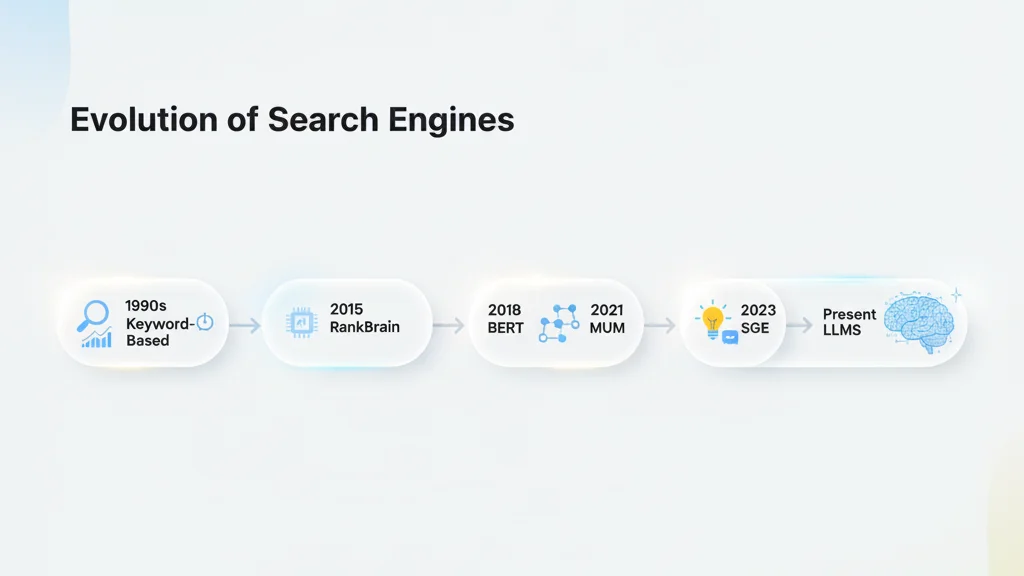
Search has greatly improved since the early days of the Internet. In the late 90s and the early 2000s, search engines were barebones. They would take the query and look for the same words on the pages.
If your page had those words the most compared to other pages, you would rank higher. This created the VERY infamous practice of keyword stuffing, where web admins would oversaturate pages with keywords to the point where they became unreadable.
As the Internet grew in popularity and accessibility, new and improved methods of search were needed. Semantic search is the method of shifting search parameters from a word-for-word analysis to an understanding of context.
For instance, “best running shoes for flat feet” used to yield results based on the words in the search. Now, Google knows to include words such as “flat feet,” “arch support,” and “motion control” in the results.
Over time, AI-driven updates transformed search:
Now, with LLMs powering both search engines and AI assistants, search isn’t just about “matching words” anymore. It’s about understanding what people mean, not just what they type.

Since the beginning of SEO, marketers have spent great amounts of time performing research to determine which keywords and phrases would yield the best results with the least amount of competition.
Three areas where keywords were indispensable included:
This strategy worked—until it didn’t. Search engines grew wise to keyword manipulation. Suddenly, repeating the same word 20 times wasn’t a winning formula anymore. Context, quality, and user experience started to matter more than raw keyword density.
Still, it’s undeniable that keywords historically shaped the entire SEO landscape. Without them, content had no roadmap. But with LLMs, the map itself is changing.

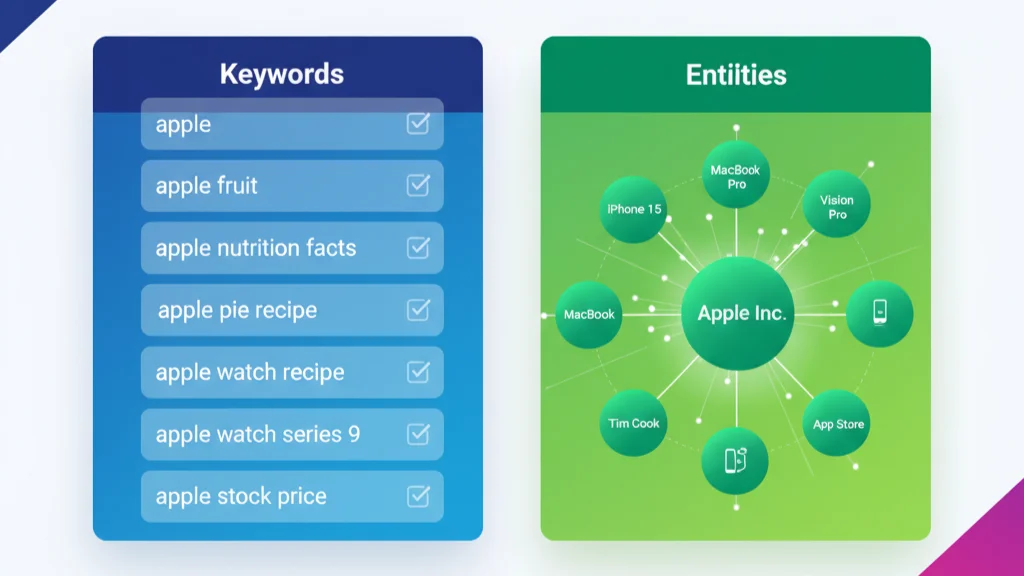
This is where things get even more interesting. LLMs do not think in terms of keywords. They think in terms of patterns of languages, meanings, and connections; for example, if a user asks, “What is the healthiest fruit for the heart?” the AI does not look through webpages buried with “healthiest fruit”, “heart”, and “health.” It looks for antioxidants, fibers, and cardiovascular benefits.
This shift means:
In short, SEO in the age of LLMs isn’t about chasing keywords but about answering questions better than anyone else.
Here’s the million-dollar question: Are keywords obsolete? The answer is no, but their role has shifted.
In essence, keywords aren’t dead; they’ve evolved. They’re no longer the star of the show, but they remain part of the supporting cast. Modern success in SEO requires a balance of semantic depth, topical authority, and natural keyword use that doesn’t slip into outdated stuffing tactics.

As the new backbone of modern optimization, semantic SEO is yet to have a rival. It does not focus on phrases or words in the same way that keyword-based strategies do, but rather context and relationships. In simple terms, the challenge is writing in a way that semantic search engines, and now LLMs, can think at a level deeper than just words.
Instead of thinking, “How many times should I use the keyword ‘digital marketing tools’?” semantic SEO pushes us to ask, “What does someone really want when searching for this?” Maybe they’re looking for pricing comparisons, case studies, or a beginner-friendly guide. By covering these angles, you’re addressing the entire intent of the query.
A huge part of semantic SEO is building topic clusters and pillar content. Imagine your website as a library. The pillar page is the “main book” on a topic (like “Ultimate Guide to Digital Marketing Tools”), while cluster articles branch off into specific subtopics (like “Best Free Tools for Startups” or “Top Analytics Platforms”). Together, they signal to Google and LLMs that you’re not just chasing a keyword—you’re an authority in the whole subject.
Why does this matter now more than ever? Because LLMs thrive on context. When AI reads your content, it isn’t scanning for repetition—it’s looking for richness, depth, and interconnections. If your site covers a topic comprehensively, the AI is more likely to trust your content as the best answer.
So, while keywords give direction, semantic SEO builds trust and authority. It’s like moving from being a street performer who knows a few songs by heart to becoming a full orchestra that can perform an entire symphony. The depth makes you unforgettable in the eyes of both humans and machines.

If LLMs are reading content like humans, then content optimization has to evolve beyond just keyword placement. This doesn’t mean keywords are gone—it means they’re just one of many ingredients in the recipe for ranking.
Here’s what matters more now:
Optimizing content today is less about sprinkling the right words and more about designing an experience. If your page feels valuable, trustworthy, and easy to consume, both users and LLMs will reward it.
Think of it like cooking: keywords are just the seasoning. Without the main ingredients (depth, authority, readability), you’ll never serve up a satisfying dish.
The way people search is changing drastically. Instead of short, clunky phrases like “best pizza in New York,” users now type or speak in full sentences: “Where can I find the best pizza near me that’s open late?” LLMs are built to handle this shift.
Here are the three biggest trends:

In the future, search may look less like “scrolling through links” and more like having a conversation with an AI. Businesses now more than ever need to provide content that is conversational and relevant to the queries asked, to seamlessly integrate in these AI conversations.
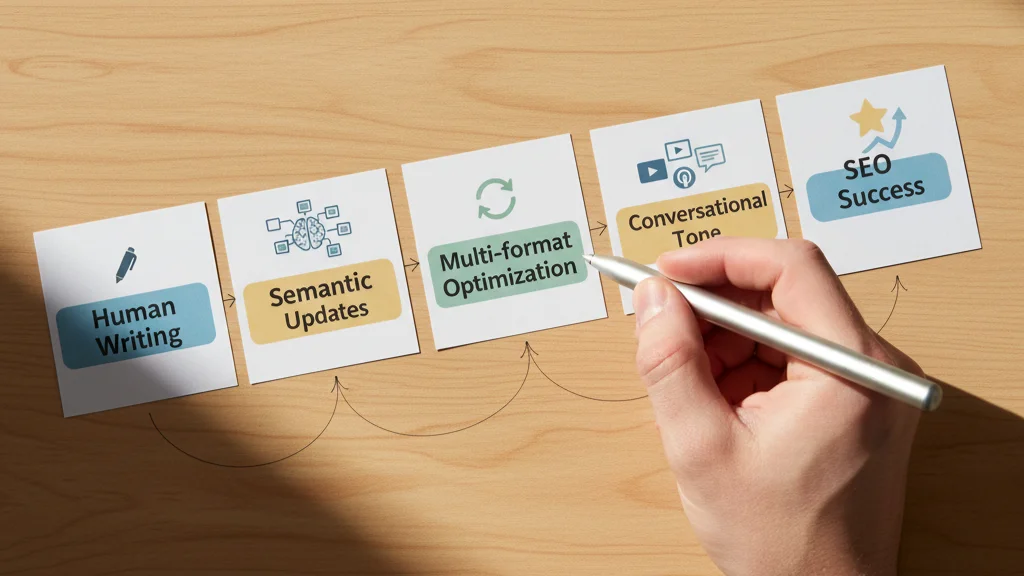
With so much change, what should businesses and creators actually do? Here are practical strategies that work in the LLM-driven landscape:
Ultimately, the winning strategy is not abandoning keywords but evolving beyond them. Think of them as a compass pointing north—but the journey itself depends on the quality of the map (semantic coverage), the road (user experience), and the vehicle (trust and authority).

It’s easy to assume that content is everything in the LLM age, but that would be a mistake. Technical SEO still matters—maybe more than ever. Why? Because even the best content can’t rank if it’s invisible to search engines or inaccessible to users.
Here are the key areas:
Think of technical SEO as the foundation of your digital house. No matter how beautiful the furniture (content) is, the house will collapse if the foundation isn’t strong.
That’s why choosing the right web development company matters. They build sites with both user experience and search visibility in mind from the ground up
In the era of LLMs, the role of technical SEO is to ensure that a site’s content can be found, understood, and interacted with in a useful way by people and machines alike.

Sometimes the best way to understand change is to see it in action. Let’s look at real-world scenarios where SEO strategies either failed or thrived in the age of LLMs.
Take the case of old affiliate sites that built their success purely on keyword stuffing and thin content. For years, these sites thrived by targeting long-tail variations like “best coffee maker 2020,” “best cheap coffee maker,” and “coffee maker reviews.” The problem? These articles were nearly identical, offering little real value beyond repeating keywords.
When Google rolled out updates like BERT and later leaned on LLM-driven search experiences, these sites collapsed. Their content didn’t answer real user intent, wasn’t engaging, and lacked topical depth. Overnight, rankings disappeared, traffic plummeted, and revenue dried up.
Semantic SEO helped HubSpot thrive as a company when everyone else was struggling.HubSpot’s approach was to create topic clusters and pillar pages rather than dozens of keyword-stuffed articles. They have a central pillar page called the “Ultimate Guide to Inbound Marketing”, which has hundreds of related posts that point to it. This helps HubSpot establish its authority in the digital marketing field and also strengthens its marketing efforts.
Search engines—and now LLMs—reward this because the site answers not just one keyword query but a whole universe of related questions.
Content platforms that embraced AI early also found success. For instance, NerdWallet structures its financial guides around natural language queries, making them easy for AI to summarize in search results. Instead of optimizing for “best credit card,” they address nuanced queries like “What’s the best credit card for frequent travellers with no annual fee?”
The lesson? Depth, authority, and semantic richness always beat shallow keyword targeting. In the LLM era, winners are those who build for meaning, not just words.
Whenever a major shift happens in SEO, myths follow. Let’s bust a few common misconceptions.
It’s tempting to believe keywords no longer matter. But the reality is that keywords still play a role—they guide AI toward understanding intent. What’s changed is that stuffing keywords won’t work anymore. Instead, keywords are signals within a scope of a broader framework of semantics.
Think of them like street signs. They don’t define the whole city, but without them, navigating gets harder.
Some people argue that with AI assistants answering questions directly, SEO is obsolete. Wrong. LLMs need high-quality content sources to pull from. If your site isn’t optimized, AI won’t surface your answers.
SEO isn’t dead—it’s just shifting toward optimizing for both search engines and AI-driven experiences. A professional SEO service provider can help bridge this gap effectively.
Another myth is that the more great content you create, the higher your chances of ranking. Not true. Even with great content, you have to have proper technical SEO, fast sites, Schema markup, and Mobile optimization not to get buried. In the world of LLMs, content is king, but technical SEO is the castle it resides in.
SEO has never been static, and the rise of LLMs proves it’s evolving faster than ever. Businesses and creators need to prepare for what’s next.
Tools like Surfer SEO, Clearscope, and MarketMuse use AI to suggest not just keywords but semantic variations, entities, and related questions. Instead of obsessing over one keyword, you can create content that covers a whole ecosystem of intent.
With the help of AI, the process of content ideation, outline drafting, and even drafting of the content becomes much more manageable. The same way we emphasize AI for content creation, there’s something AI is deficient in – human experience.
Strategies that incorporate the effectiveness of AI and the authenticity of human know-how in SEO are the best. E-E-A-T and long-term trust are the only elements that get built through that focus.
The only constant in SEO is change, and that is something brands have to accept. Instead of sticking to SEO methods that are no longer effective, focus on decreasing. Test, analyze, then adjust. The websites that withstand shifts in the future are the websites that tailor SEO to be a dynamic system that requires constant change rather than a checklist.
So, do keywords still matter in the age of LLMs? The short answer: yes, but not in the way they used to.
The importance of keywords is still there, as they aid as pointers; however, real ranking power is attributed to user engagement, technical proficiency, semantic depth, domain authority, and relevant content. LLMs equally reward content that is human-like, complete, and trustworthy.
The future of SEO lies not in chasing algorithms but in understanding humans better than ever. If your content solves problems, answers questions naturally, and builds trust, both search engines and LLMs will put you in the spotlight.
SEO isn’t dying—it’s evolving. The smart players aren’t asking, “Are keywords dead?” They’re asking, “How can we use keywords as part of a broader strategy that speaks to humans and AI alike?”
1. Do keywords still matter in 2025 and beyond?
Yes, but they are no longer the primary focus. Keywords only act as signposts; topical authority, semantic SEO, and contextual relevance now hold more importance.
2. How do LLMs like GPT-5 affect Google rankings?
Such systems focus on the intent and context of content rather than the exact keywords. The depth and domain authority of the content are still important.
3. Should I stop doing keyword research entirely?
No. Keyword research is still useful, but should be paired with entity research, semantic analysis, and intent mapping.
4. What’s the difference between keywords and entities?
Keywords are words or phrases, while entities are concepts, people, places, or ideas. Entities help search engines understand context more accurately.
5. How can small businesses adapt SEO strategies in the AI era?
Focus on quality over quantity. Build topical authority, create helpful content, optimize for local search, and keep technical SEO strong.