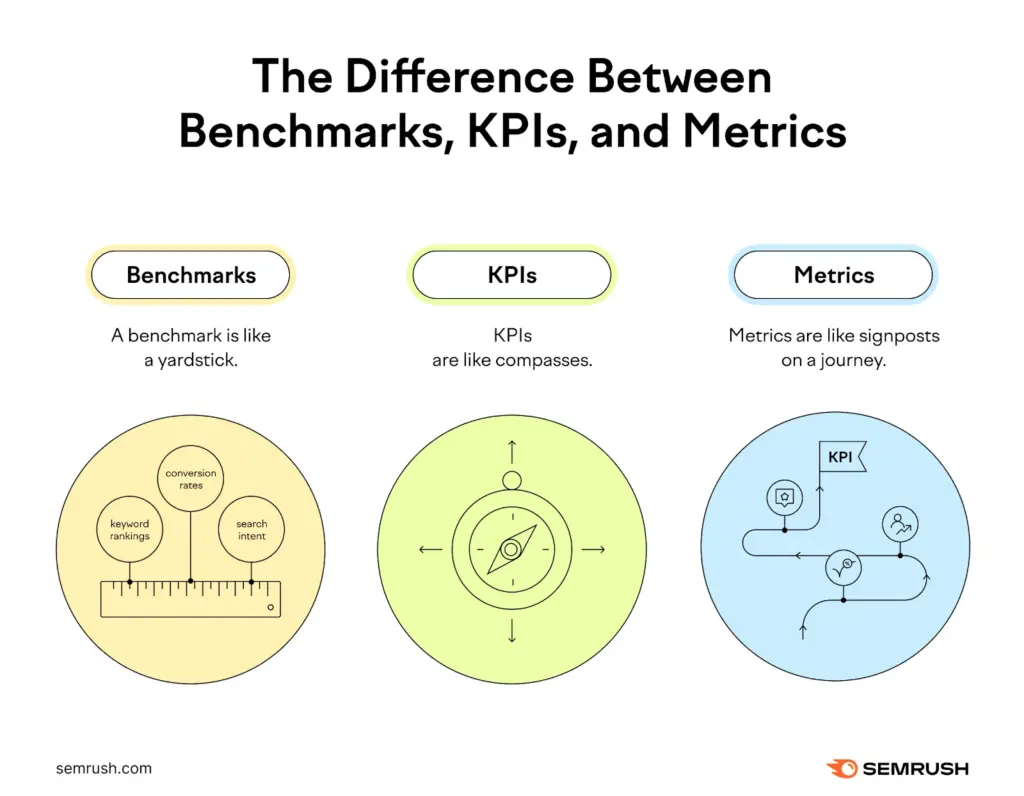
If you’re running a business and still ignoring SEO benchmarking, you’re practically handing leads to your competitors.
Sounds harsh? Maybe. But it’s the truth.
Search engine optimization isn’t a “set-it-and-forget-it” kind of game anymore. It’s a long-term strategy, and like any strategy, you need metrics—reliable, insightful, and actionable metrics. That’s where SEO benchmarking steps in.
SEO benchmarking isn’t some optional marketing gimmick. Whether you’re a startup founder trying to make a dent in your industry or a seasoned business owner aiming to scale up, this article is your comprehensive guide.
We’ll break down what SEO benchmarking is, why it matters, how to do it right, and where most people mess it up.
Oh, and did I mention the FREE SEO Benchmarking Checklist & Guidelines you can grab at the end? Stick around—it’s packed with practical steps to make your SEO process smoother and more effective.
SEO benchmarking is the process of measuring your website’s search performance against your past results, competitors, and industry standards. Think of it as a “health report” for your digital presence. It gives you quantifiable insights into your visibility, rankings, traffic, and engagement metrics.
For instance, if your website traffic grew by 20% last quarter, that sounds great — but compared to what? Is that 20% higher than your competitors or just a result of seasonal demand? Benchmarking adds that context, turning raw data into actionable insights.
It’s important to note that benchmarking goes beyond simple analytics. Analytics tell you what happened — benchmarking tells you why and how it compares to others in your niche. It’s the difference between tracking steps on a fitness app and having a personalized training plan based on your progress over time.
Think of it as setting the GPS before a road trip. Without knowing your starting point, how do you know if you’re headed in the right direction?
Here’s what SEO benchmarking involves:
Unlike basic analytics, benchmarking compares your progress against industry standards and competitors. It’s competitive analysis + performance tracking rolled into one. That combo? It’s marketing gold.
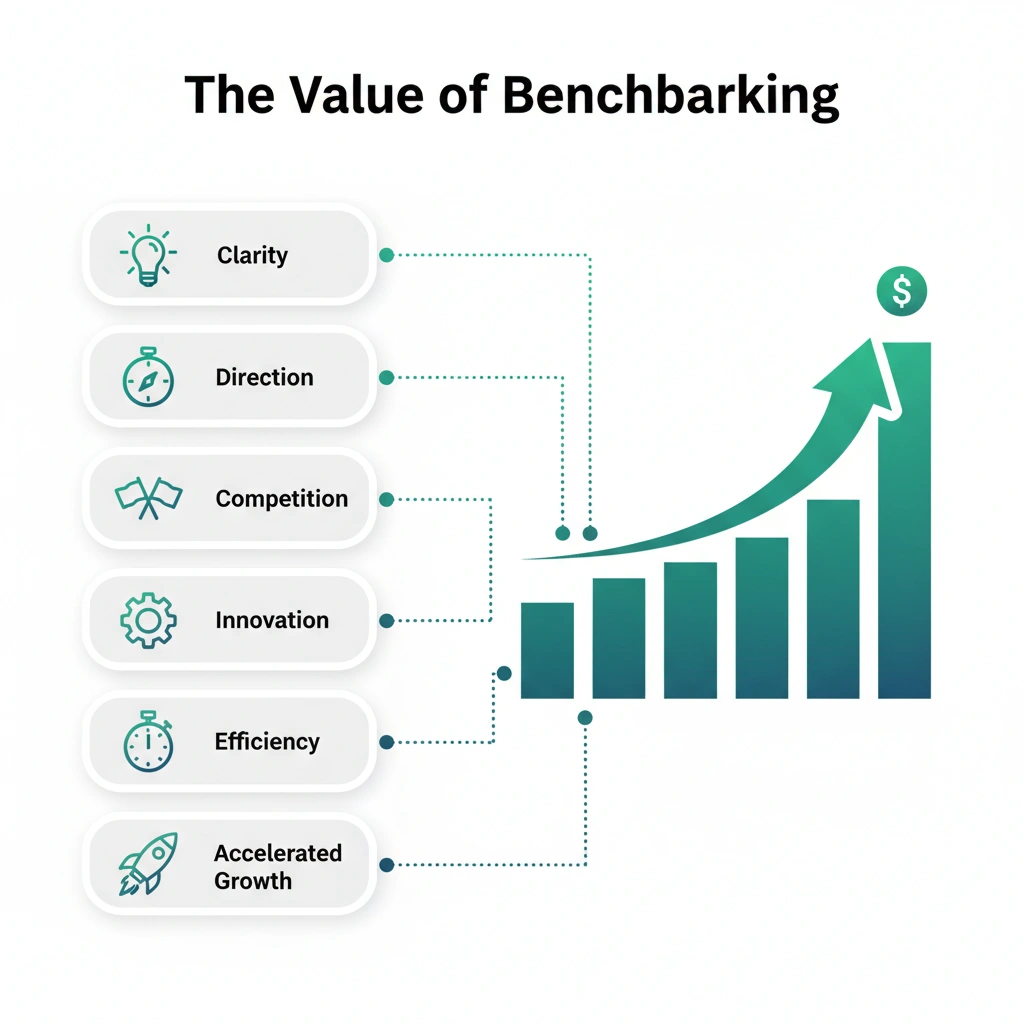
So why should you, as a business owner, actually care?
Because guesswork won’t cut it anymore. The digital marketplace is crowded. If you’re not actively tracking how your site performs compared to competitors and your own goals, you’re likely missing out on sales, traffic, and leads.
Here’s what proper SEO benchmarking offers:
For example, let’s say your blog ranks #10 for a high-converting keyword. That’s decent, but SEO benchmarking tells you how long you’ve been there, how your competitors are doing, and what changes could push you up to #3 or #1. That could mean thousands more in monthly revenue.
Without these insights, you’re optimizing blindfolded. With them, you’re steering with precision.
SEO benchmarking isn’t just one number. It’s a collection of performance signals, and here are the four key pillars to focus on:
1. Keyword Rankings – This is the heartbeat of your SEO strategy. Are you ranking for keywords your customers are searching? If not, you’ve got a visibility problem.
2. Organic Traffic – This shows how many visitors are landing on your site from search engines. A steady upward curve? Good sign. Random spikes and drops? You may have a problem.
3. Backlink Profile – Quality backlinks from reputable websites still matter—a lot. Benchmarking helps you track link growth, authority scores, and even spam risks.
4. On-Page Optimization – Are your pages optimized with the right title tags, meta descriptions, internal links, and headings? Benchmarking includes these technical on-page checks.
Together, these components give a complete picture of how your website stacks up—and where it needs work.
Setting benchmarks is more than just tracking numbers; it’s about defining what “success” really looks like for your business. A common mistake many entrepreneurs make is setting unrealistic or irrelevant targets—like trying to compete with Amazon when you’re a local retailer.
Here’s how to set meaningful, results-driven SEO benchmarks:
1. Use your historical performance as a baseline.
Look back at your metrics from the last 6–12 months. What was your average organic traffic? How many leads or sales did you get from search? This becomes your starting line.
2. Analyze your competitors.
Use tools like Ahrefs or SEMrush to see where your top competitors rank. Identify which keywords they dominate, how strong their backlink profiles are, and how their content performs.
3. Set SMART goals.
Every benchmark should be Specific, Measurable, Achievable, Relevant, and Time-bound. For instance:
4. Customize your benchmarks by channel.
Local SEO goals differ from eCommerce or B2B SEO. Tailor your metrics to your niche and objectives.
When you combine realistic expectations with solid data, benchmarks transform from vague aspirations into actionable roadmaps for growth.
Alright, let’s get technical (but not too much).
Benchmarking without proper measurement tools is like trying to drive at night without headlights. Thankfully, modern SEO platforms make it easy to gather accurate data.
Essential Tools for SEO Benchmarking:
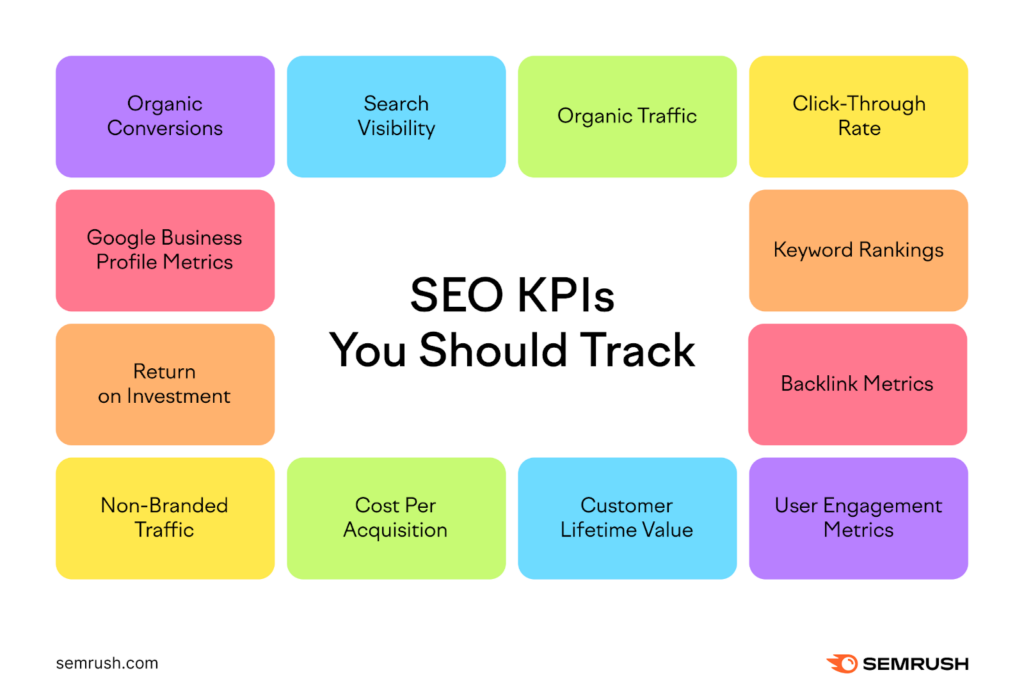
Key SEO KPIs to Track:
| Metric | Why It Matters |
| Organic Traffic | Shows how well your site attracts visitors through search. |
| Keyword Rankings | Tracks visibility for your target phrases. |
| Click-Through Rate (CTR) | Indicates how compelling your titles and snippets are. |
| Bounce Rate & Time on Page | Reveals engagement and content relevance. |
| Conversion Rate | Measures ROI of your SEO efforts. |
| Domain Authority (DA)/Rating (DR) | Reflects backlink strength and site authority. |
The key is consistency. Measure at regular intervals (monthly or quarterly) using the same tools and metrics to ensure accuracy.
Let’s talk about the elephant in the digital room—your competitors. Because no matter how good your SEO is, someone out there is doing something better… or worse. Knowing both helps you win.
Competitive SEO benchmarking is the practice of comparing your SEO metrics with those of your top competitors. It’s not spying—it’s strategic learning.
Start by identifying your top three to five competitors. These may not be the companies you compete with offline but rather the ones dominating your search results for relevant keywords.
What You Should Look At:
How to Benchmark Competitors:
Then ask yourself: What’s one thing they’re doing that I can improve upon? Even small tweaks based on competitive insights can result in significant performance shifts.
This process reveals both opportunities and threats. Maybe your blog is outperforming competitors, but your backlink profile is weak. Or perhaps their content targets questions your audience frequently asks—that’s your chance to fill a gap and claim new rankings.
Competitive benchmarking turns rivalry into research—and research into revenue.
Keywords are like the GPS coordinates in the SEO map. If you’re not tracking them, you’re essentially wandering blind.
Why Keyword Benchmarking Matters?
Steps to Benchmark Keywords:
By benchmarking keyword trends over time, you’ll know whether your SEO strategy is resonating or needs refinement.
Pro Tip: Don’t just chase high-volume keywords. Long-tail keywords can bring in more qualified traffic with less competition. Benchmarking helps uncover those goldmines.
Let’s get a little geeky, shall we?
Your website’s technical health is like the base of a house—if it’s weak, everything else crumbles.
To say that, Technical SEO is the foundation of all your on-page and off-page efforts. Without it, even the best content won’t rank.
What to Benchmark:
Tools for the Job:
Benchmark these technical metrics quarterly. Even small fixes—like compressing images or improving server response time—can significantly improve rankings and user satisfaction.
Backlinks remain one of Google’s most influential ranking factors. However, not all links are created equal. It’s not just about the number of links—it’s about their quality, relevance, and consistency.
Metrics to Benchmark:
| Factor | What It Measures |
| Total Backlinks | Overall number of links to your domain. |
| Referring Domains | How many unique websites link to you. |
| Domain Authority (DA) / Rating (DR) | Indicates credibility of your site. |
| Anchor Text Diversity | Prevents over-optimization penalties. |
| Link Velocity | Tracks how fast you gain or lose backlinks. |
Benchmark your backlink profile against your top three competitors. Are they getting mentions from authoritative sources like Forbes or industry blogs while your links come from low-value directories? That gap represents your next outreach or PR opportunity.
Quality trumps quantity every time. Ten strong backlinks can outweigh hundreds of weak ones.
Backlink benchmarking gives you a roadmap to build a more authoritative and credible online presence.
And in SEO, authority = rankings.
Content is the magnet that attracts organic traffic—but not all content performs equally. You’ve got blogs, landing pages, maybe even videos—but how are they actually performing?
Content benchmarking helps you evaluate what’s resonating with your audience and what’s falling flat.
Metrics to Measure:
Ask yourself:
Use these metrics to identify top-performing pages—then analyze what makes them successful. Is it the topic, headline, format, or visuals? Replicate that formula.
At the same time, look for underperforming pages. Update outdated content, improve readability, or add internal links. Benchmarking keeps your content strategy agile and aligned with audience needs.
For local businesses, Google Maps and “near me” searches are the real battlegrounds.
Key Areas to Benchmark in Local SEO:
Use tools like BrightLocal or Whitespark to monitor local performance. Improving your local benchmarks often results in immediate real-world traffic—more calls, bookings, and footfall.
Local SEO benchmarking can make or break a small business—especially in service-based industries.
Even with the best intentions, many business owners fall into some pretty nasty SEO benchmarking traps. And the worst part? These mistakes don’t just skew your data—they send your strategy in the wrong direction entirely.
Let’s break down the most common errors so you can steer clear of them.
1. Focusing Only on Vanity Metrics
Sure, it feels good to see your site traffic spike. But traffic alone means nothing if those visitors don’t convert. Don’t chase numbers that make you look good—focus on metrics that drive leads, sales, or engagement. That’s where real ROI lives.
2. Ignoring Seasonality
If your SEO traffic dipped in December, was it a performance issue—or did your audience just take a holiday break? Always benchmark against similar timeframes (YoY or MoM) to factor in natural fluctuations.
3. Using Inconsistent Tools
Using one tool this month and a different one next month? You’ll get inconsistent data, and your benchmarks will be meaningless. Stick to a consistent tech stack for accuracy and clarity.
4. Ignoring User Intent
Just because you rank #1 for a keyword doesn’t mean you’re winning. If that keyword doesn’t align with user intent—or bring in qualified traffic—it’s just noise. Your benchmarks must be rooted in relevance, not just reach.
5. Lack of Clear Goals
If you’re benchmarking just for the sake of it, you’re wasting time. Each benchmark should tie back to a business goal—like boosting lead generation, increasing brand visibility, or growing your email list.
Avoiding these pitfalls ensures your benchmarks reflect reality—and help you make smarter, data-backed decisions.
Okay, so you’ve collected a ton of data. Now what?
You turn it into an actionable SEO benchmarking report—something you (or your team) can reference regularly to track performance and guide strategy.
What to Include:
Tools That Can Help:
Make it visual. Use charts, graphs, and scorecards to highlight trends. And most importantly—make sure it’s actionable, not just informative.
Data without action is just a spreadsheet. Once you’ve benchmarked your SEO performance, it’s time to do something with that insight.
Here’s how to turn your benchmarks into strategy:
1. Identify Quick Wins – Maybe you’re ranking #7 for a money keyword. A little internal linking, a stronger meta description, or better content could bump you to page one.
2. Double Down on What Works – If a few blogs are driving major traffic and conversions, replicate that format. Expand on those topics. Create spin-off content.
3. Fix Weak Spots – Pages with high bounce rates or declining rankings? Re-optimize or prune them entirely. Benchmarks will tell you what needs attention.
4. Plan Future Campaigns – Use keyword and content benchmarking to guide your next quarter’s content calendar. Match high-opportunity keywords with new blog posts or landing pages.
5. Allocate Resources Wisely – Benchmarks help justify where to invest more—whether it’s link building, content creation, or technical SEO fixes.
Benchmarking isn’t about perfection—it’s about continuous, data-driven improvement. Review your SEO benchmarks quarterly, at minimum. SEO is always evolving—your strategy should too.
Because you’ve made it this far (seriously, kudos!), here’s something that’ll help bring clarity to your SEO strategy—a FREE SEO Benchmarking Checklist & Guidelines created to simplify how you measure, track, and improve your website’s performance.
This is not a boring spreadsheet. It’s a comprehensive, easy-to-follow PDF guide packed with practical steps, expert insights, and everything you need to benchmark your SEO like a pro.
What’s Inside This Download:
How to Use It:
Stop guessing. Start benchmarking with clear, actionable steps that elevate your SEO strategy.
Download NowSEO benchmarking isn’t just another task on your digital to-do list—it’s a mission-critical process for growth-minded businesses.
By consistently measuring where you stand and where you want to go, you give your SEO strategy clarity, direction, and momentum. Whether you’re a solopreneur or running a large marketing team, benchmarking turns vague goals into clear action steps.
Don’t settle for “we think it’s working.” Start knowing for sure.
Download the free template. Review your benchmarks. Then tweak, test, and thrive.
Because in SEO, the only thing worse than bad performance… is not knowing your performance at all.
1. What is a good SEO benchmark?
A good SEO benchmark depends on your industry and goals. For example, a 10% increase in organic traffic quarter-over-quarter, or ranking in the top 3 for your primary keyword, could be solid goals. It’s all about context.
2. How often should I review my benchmarks?
Ideally, review them monthly for fast-moving campaigns, and quarterly for long-term strategies. A full SEO audit and benchmark review should be done at least every 90 days.
3. Do small businesses need SEO benchmarking?
Absolutely. In fact, small businesses may benefit the most. With limited budgets, benchmarking ensures you’re making data-driven decisions and investing in what actually works.
4. Can I do SEO benchmarking without paid tools?
Yes. Tools like Google Analytics and Google Search Console are free and very powerful. However, paid tools like Ahrefs or SEMrush offer deeper insights and competitor data that can enhance your benchmarking process.
5. How do I know if my SEO strategy is working?
If your organic traffic, keyword rankings, and conversions are trending upward consistently—and if you’re gaining ground on competitors—then your strategy is likely working. Benchmarking makes that crystal clear.
6. How long does it take to see results from SEO benchmarking?
SEO benchmarking itself doesn’t produce results—it highlights where improvements are needed. However, once you take action based on your benchmarks (like optimizing content or fixing technical issues), you can typically see noticeable changes within 3 to 6 months, depending on competition and industry.
7. Should I hire an SEO expert for benchmarking or can I do it myself?
You can definitely start benchmarking on your own using free tools like Google Analytics and Search Console. But if your website is large, or if you’re unsure how to interpret the data, hiring an SEO expert or agency can save time and ensure you’re making the right decisions based on your benchmarks.
8. What’s the difference between SEO auditing and SEO benchmarking?
An SEO audit is a one-time, deep-dive analysis of your website’s health and performance. SEO benchmarking, on the other hand, is ongoing—it tracks your progress over time and compares it against competitors or industry standards to guide your long-term SEO strategy.
9. How do I benchmark against competitors if I don’t know their data?
While you can’t access a competitor’s Google Analytics, tools like Ahrefs, SEMrush, or Ubersuggest let you see estimated traffic, backlinks, keyword rankings, and more. You can use this data to build a reasonably accurate competitive SEO benchmark.
10. Is benchmarking useful for eCommerce SEO?
Absolutely. eCommerce businesses can use SEO benchmarking to track product page rankings, category visibility, organic conversions, and even seasonal performance. It’s especially valuable in competitive markets where small changes can lead to big revenue shifts.
11. What’s the best frequency for SEO benchmarking?
It depends on your business goals and resources. Monthly is ideal for fast-moving campaigns or highly competitive industries. Quarterly works well for most small to medium-sized businesses. The key is consistency—benchmark at regular intervals to spot trends.
12. Can benchmarking help me recover from an SEO traffic drop?
Yes, and it’s one of the best ways to figure out what went wrong. Benchmarking can help you identify whether the drop is due to algorithm updates, lost backlinks, technical issues, or ranking declines—so you can act fast and start recovering.
13. What’s the most important metric in SEO benchmarking?
There’s no one-size-fits-all answer. For some, it’s organic traffic. For others, it’s keyword rankings, conversion rate, or backlink growth. Your most important metric depends on your business goals. Benchmarking helps you identify and track the ones that matter most.
14. Do social signals factor into SEO benchmarking?
Social shares don’t directly impact SEO rankings, but they can boost visibility, increase backlink opportunities, and drive traffic. So while not a core SEO ranking factor, it’s worth benchmarking how your content performs on social media and the traffic it brings.
15. Can SEO benchmarking help with content strategy?
100%. By benchmarking which types of content perform best—blogs, videos, product pages, etc.—you can shape your content calendar around what works. It also reveals keyword opportunities and underperforming content that needs updating or deleting.