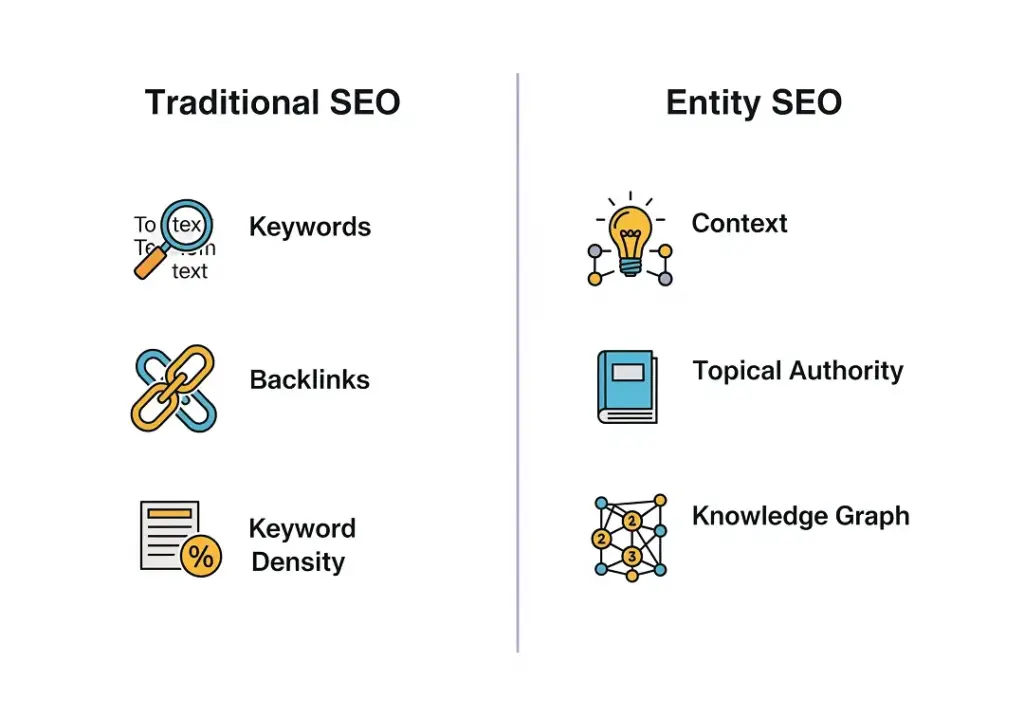
The SEO universe is changing, perhaps even more rapidly than in the past, and the backbone of that change is one important word: entities.
In the past, marketers have been obsessed with keywords. The strategy was simple—find the right set of words your audience was typing into search engines and optimize your content around them.
But today, the game has changed. Search engines like Google and others no longer search simply based on keywords. Instead, they understand the deeper connections between concepts, people, organizations, places, and things—all of which are entities.
In the current era of AI, where search algorithms are informed by machine learning and natural language processing, search engines have a significantly deeper focus on context, relationships, and user intentions.
This shift means that businesses seeking to establish their online presence must now adopt Entity SEO. Elevating your brand to a recognized entity will enhance visibility, increase authority, and ensure your brand remains relevant in the future.
So why does this matter to your brand?
Imagine your business not just ranking for keywords but becoming part of the knowledge graph that Google references whenever someone searches for your industry, services, or even your name. That’s the power of entity SEO—it transforms your brand into a trusted reference point in the digital landscape.
SEO still holds some importance, but is bound to traditional techniques. Search engines have become smarter and more advanced; there is no more room for keyword stuffing or superficial optimization work.
For example, take the word “Apple.” There are billions of searches and, for every one of them, the search engine needs to understand the exact meaning, “Apple” the fruit or “Apple” the phone maker. That melt of differentiation is made using the identification of names and their entity relations.
As AI continues to advance, search engines prioritize contextual understanding over keyword density. Brands that fail to adapt risk becoming invisible in search results, no matter how many blog posts or backlinks they generate.
That’s why entity SEO is not just an upgrade, it’s a survival strategy in the AI-driven search ecosystem!
Artificial intelligence has completely changed how search engines interpret and deliver results. Google’s AI models, such as RankBrain, BERT, and now MUM (Multitask Unified Model), don’t just crawl pages; they interpret the meaning, relationships, and even emotions behind searches.
Users, on the other hand, have also shifted their behavior, thanks to voice search, conversational AI assistants, and chatbots.
Instead of typing fragmented keywords like “best SEO tool,” people now ask natural language questions like “What is the best SEO tool for small businesses in 2025?” This conversational shift requires search engines to understand entities and their context, not just strings of words.
In this new ecosystem, brands recognized as authoritative entities gain an advantage.
Suppose your brand is identified as the go-to source for a specific topic. In that case, AI-driven search engines will present your business more frequently, across multiple platforms, in ways traditional SEO could never achieve.
Entity SEO sounds technical, but at its core, it’s about clarity and recognition. An entity is essentially anything that exists as a distinct and identifiable concept. Google defines an entity as “a thing or concept that is singular, unique, well-defined, and distinguishable.”
That means a brand, product, service, location, or even an individual can be treated as an entity. When search engines understand your brand as an entity, they no longer just associate you with keywords but with meanings and relationships.
Think of entities as the building blocks of knowledge. For example:
In SEO, when your brand becomes an entity, search engines recognize it in a broader context. Instead of just linking you to one keyword, they link you to an entire ecosystem of topics, relationships, and contexts.
This is why entity SEO is incredibly powerful for branding; it transforms your business from a keyword chaser into a recognized authority.
While keywords still matter, they are only scratching the surface. For instance, “Nike running shoes” is a keyword.
An entity would be Nike, whose associations included global brands, fitness, shoes, athletes, and sponsorships. As we can see, search engines understand Nike at a deeper, more complex level.
By concentrating on entities, brands don’t just rank for random phrases. Instead, brands are more likely to be positioned as trusted industry authorities. This means your brand is far more likely to appear in knowledge panels, voice search results, and AI-powered recommendations.
The Google Knowledge Graph is the backbone of entity SEO. Launched in 2012, it’s a massive database that maps relationships between entities—people, brands, products, events, and more.
If you search for “Leonardo da Vinci,” for example, you will see a biography, and also included are his artworks, contemporaries, and places related to his life.
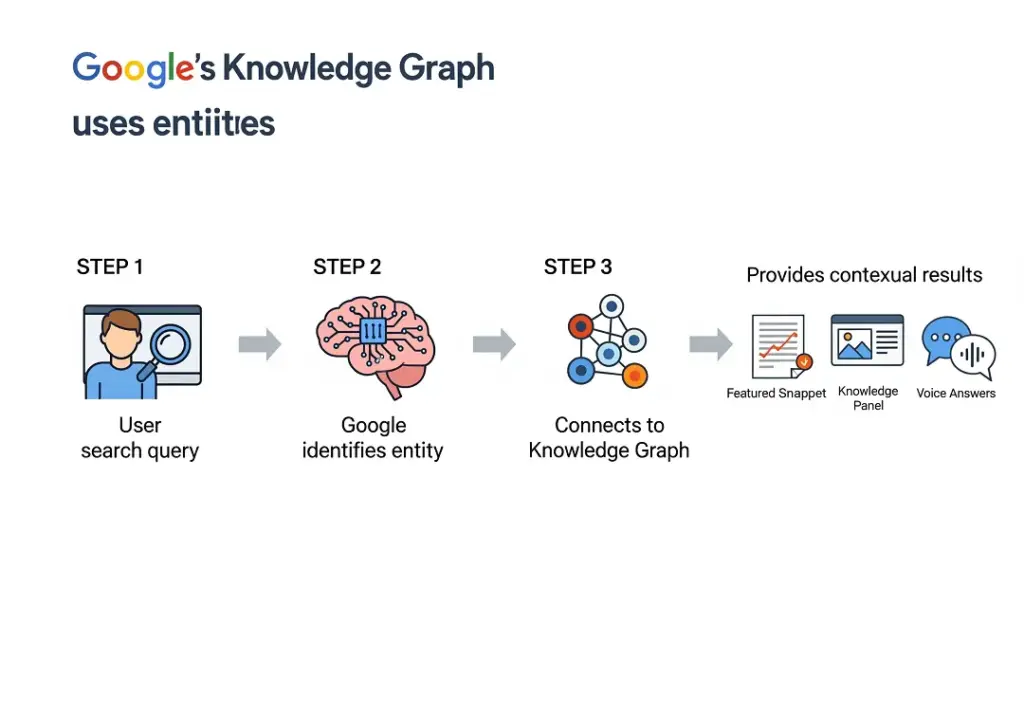
When your brand becomes part of the Knowledge Graph, it gains a significant competitive edge. Google starts associating you with relevant concepts, industries, and authoritative sources. That means your brand isn’t just another website—it’s a recognized entity woven into the web of knowledge.
Artificial intelligence is the main reason behind the rise of entity SEO.
Unlike old algorithms that relied on static rules, AI uses machine learning and NLP to interpret meaning at scale. This helps search engines to understand complex queries and connect them with the right entities.
Search engines can “understand” a lot of queries as a result of billions of searches. Machine learning helps with this. Understanding of language, context, and intent is the work of natural language processing. The combination of the two helps in understanding context in semiotic communication.
For example, suppose someone searches “Who is the founder of Tesla?” The search engine doesn’t just match keywords. In that case, it recognizes “Tesla” as an entity (a company) and “Elon Musk” as a related entity (a person).
Google search algorithms are becoming more AI-focused with dedicated entities. BERT and MUM are two such updates whose purpose is to analyze entities with greater depth.
Search engines no longer show “ten blue links” but answer queries with direct answers, snippets, and even knowledge panels containing entities.
This means that if your brand is properly structured as an entity, you have a much higher chance of appearing in these AI-driven results—even over competitors with more backlinks or content volume.
Voice search and AI assistants like Siri, Alexa, and Google Assistant rely heavily on entities. When you ask, “What’s the best pizza place near me?” the assistant doesn’t just look for keywords—it identifies “pizza” as a food entity, “place” as a business entity, and “near me” as a location entity.
This is critical for brands as it highlights the importance of Entity SEO for discoverability in conversational searches. AI Assistants are far more likely to recommend recognized entities during real-time AI interactions.
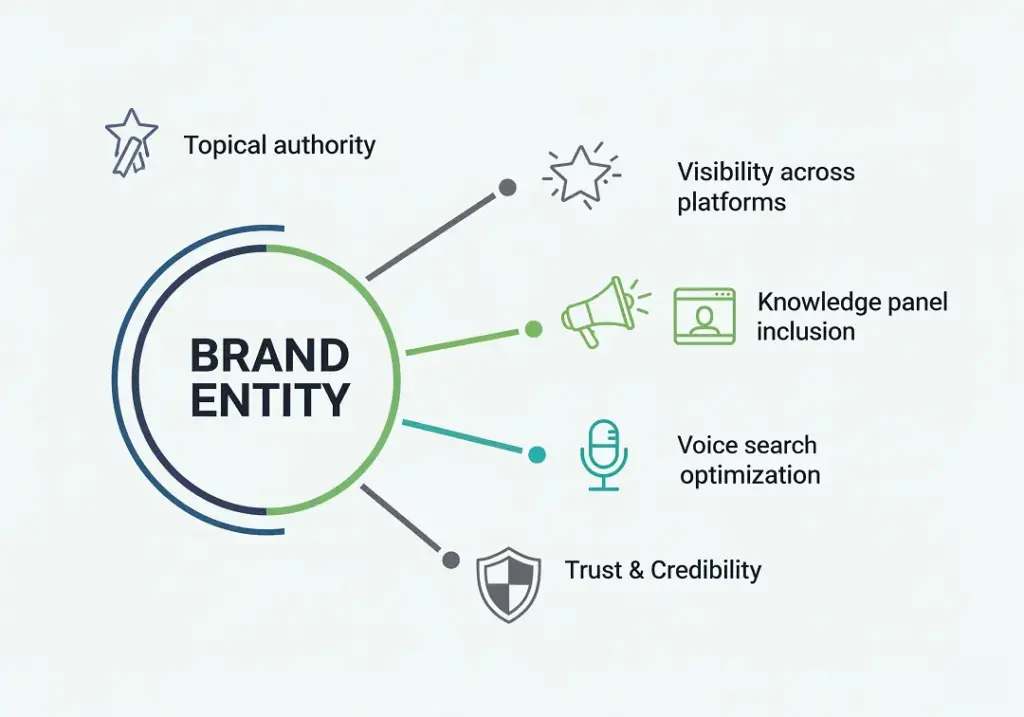
Entity SEO is not just a technical adjustment—it’s a branding superpower. By positioning your brand as a recognized entity, you open doors to greater visibility, trust, and authority.
Our expert SEO services are designed to help you leverage entity SEO for maximum brand growth.”
When search engines see your brand consistently linked to a specific topic, you begin to establish topical authority. For example, if you run a cybersecurity company and publish content, gain mentions, and appear in discussions around data protection, AI will start associating your brand with that niche. Over time, you’ll become a default authority entity for cybersecurity-related searches.
Entity SEO works to ensure that your brand is not only represented on Google search, but also on:
With this kind of presence, your digital footprint is multifaceted, and you are not restricted to traditional search ranking.
Entities do well on structured data.
When you employ schema markup, you send a clear signal to search engines on who you are, what you do, where you relate with other entities, and where you connect with other entities as you do business with those with whom you do business. Because users are increasingly likely to trust brands that show in rich results with corroborated data, this increases credibility.
Structured data also increases your chances of being included in Google’s Knowledge Graph, which adds another layer of trust and recognition. So make sure to test your schema markup after implementing it.
Let’s look at the actionable steps to use entity SEO to build your brand after understanding the significance of entities.
The first step in entity SEO is defining what your core entity is. Ask yourself:
For example, if you’re a digital marketing agency, your core entity might be “digital marketing” with sub-entities like “SEO,” “content marketing,” and “paid ads.” By clearly defining this identity, you help AI recognize and categorize your brand correctly.
Schema markup tells search engines and AI what your brand represents. It is a digital dictionary for them. By adding a schema on your site, you help AI associate your brand with relevant entities.
For example, you can use a schema to specify:
By using this structured data, your brand entity’s visibility undergoes a boost, helping your brand get recognized as an entity in the Knowledge Graph.
Content has always been the backbone of SEO, but in the AI era, not all content is created equal. To strengthen your brand as an entity, you need to produce content that clearly reinforces what your brand stands for and how it relates to other entities in your industry.
Instead of chasing random trending keywords, focus on content clusters around your brand’s core entity. For example, if your brand is in the fitness industry, don’t just publish an article on “best running shoes.” Create a comprehensive content ecosystem that connects related topics—running techniques, injury prevention, training routines, nutrition for athletes, and so on. This helps search engines see your brand as a trusted authority entity in fitness.
Another crucial factor is semantic relevance. AI doesn’t just look at individual keywords—it evaluates whether your content meaningfully answers user intent. That means incorporating synonyms, related terms, and contextual depth. For example, if you write about “digital marketing,” your content should also touch on related entities like “SEO,” “social media advertising,” and “content strategy.”
Lastly, credibility matters more than ever. Incorporating author entities (e.g., showing the expertise of your writers), citing authoritative sources, and publishing long-form, in-depth content signals to AI that your brand is a reliable knowledge source. Over time, this reinforces your entity in the search ecosystem.
While your website is part of the equation, it isn’t the only piece of the puzzle. To truly build your brand with entity SEO, you need off-site signals that confirm your entity’s relevance and credibility. Social media and PR play a massive role in this.
Think of every social media profile—LinkedIn, Twitter, Instagram, Facebook—as an extension of your entity. By keeping your branding consistent (same logos, bios, and messaging), you help AI connect these profiles back to your brand entity. Additionally, when your content gets shared across platforms, it creates co-citations that reinforce your entity’s presence in digital conversations.
PR is another powerful tool. Getting featured in reputable news outlets, blogs, and podcasts increases the number of entity mentions your brand receives online. Even if these mentions don’t come with backlinks, AI algorithms use them as signals of authority.
For example, if your brand is mentioned in Forbes or TechCrunch, Google’s AI begins associating your brand entity with trusted sources in your industry. Over time, this improves your chances of appearing in knowledge panels and featured snippets.
The key takeaway here is simple: entities live beyond your website. The more consistently your brand appears across digital ecosystems, the stronger its entity recognition becomes.
Knowledge panels and featured snippets are some of the most useful real estate in search results, and both are deeply tied to entity SEO. When your brand becomes recognized as an entity, you increase your chances of being showcased in these sections.
A knowledge panel is that box you often see on the right-hand side of Google search results. It provides a quick overview of an entity, such as a company, person, or place. Appearing here instantly boosts your credibility because users see you as a verified entity.
To optimize for knowledge panels, you need:
Featured snippets, often called “position zero,” are short answers shown at the top of the search results. AI pulls these directly from entities it recognizes as authoritative.
To optimize for snippets, structure your content with:
If your brand consistently provides well-structured, trustworthy content, AI will reward you by elevating your content into snippets and knowledge panels.
Backlinks have always been a core ranking factor, but in the entity SEO era, mentions without links also carry weight. Search engines are now clever enough to recognize when your brand is referenced, even if there’s no direct hyperlink.
For example, if a popular news site writes, “According to digital marketing firm XYZ Agency,” that mention strengthens XYZ Agency as an entity in Google’s eyes—even without a backlink.
Still, backlinks remain essential for signaling authority. The key difference is that AI now evaluates quality and relevance over quantity. A single backlink from a highly authoritative, contextually relevant site is worth far more than many low-quality links.
Practical ways to earn both backlinks and mentions include:
By combining backlinks and unlinked mentions, you create a strong entity footprint that signals credibility to AI-driven search engines.
As with traditional SEO, entity SEO also requires tracking and measuring. This time, instead of monitoring keyword rankings, the brand’s recognition as an entity needs to be assessed.
Here are some key metrics to watch:
To track the above signals, you can use Google Search Console, Ahrefs, SEMRush, or Kalicube Pro, which is focused on entity SEO.
The final aim is not merely to rank high on keywords but to achieve multi-context recognition as a trusted entity, which guarantees sustained visibility and credibility in the search landscape.
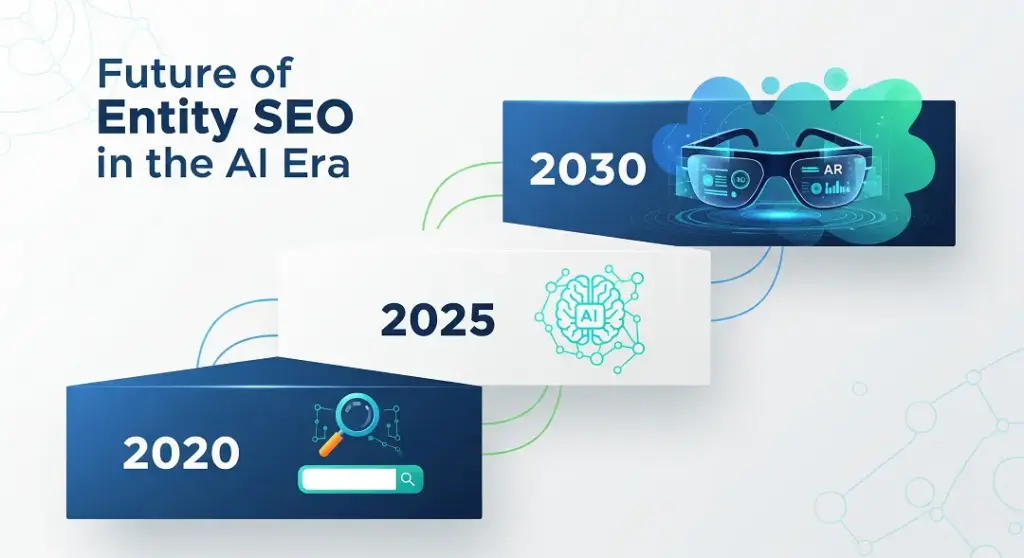
Entity SEO is not just a passing trend—it’s the foundation of how AI-driven search will evolve in the coming years. As artificial intelligence becomes more advanced, the focus will move away from traditional ranking signals and toward entity relationships, credibility, and trustworthiness.
Google’s MUM algorithm is a great example of this future. Unlike older models, MUM can understand multiple languages, analyze images and videos, and connect them back to relevant entities. This means that your brand’s content—whether it’s a blog post, a YouTube video, or a podcast—will all contribute to your entity recognition.
Another future trend is the rise of personalized search powered by AI. Search engines won’t just recommend entities based on relevance but also on user context—location, history, preferences, and behavior. If your brand is a strong entity in your niche, AI will prioritize showing you to the right users at the right time.
In short, brands that use entity SEO now are making sure their digital presence will last for a long time. People who ignore it risk becoming invisible in the AI-driven internet of the future.
Let’s review some real examples of Entity SEO:
Nike is no longer just a keyword-spamming company. It is now connected to athletes, sports, shoes, and a lifestyle. “Nike” is a strong company identifier and comes up first in search results not just for sports shoes but also for broader terms such as “sportswear” and “athletic performance”.
HubSpot positions itself as the go-to entity for inbound marketing. Through consistent publishing of research, educational content, and industry tools, HubSpot is recognized by search engines as an authority. As a result, it frequently appears in featured snippets and knowledge panels for marketing-related searches.
While not a brand in the traditional sense, Wikipedia is the ultimate entity-building machine. Every article is structured around entities and their relationships. This is why it dominates search results and why having a Wikipedia page dramatically strengthens a brand’s entity recognition.
What can we learn? Spending on building and entity identity instead of just focusing on keyword optimization and search chasing gives brands a competitive edge.
Like any strategy, entity SEO can fail if executed poorly. Here are the most common mistakes brands make:
Avoiding the above ensures that your entity-building strategy achieves long-term success.
To master entity SEO, you’ll need the right tools. Here are some of the most effective:
The AI-driven search landscape is growing at a quicker pace than businesses can keep up with. By integrating these tools, sharpening your entity SEO tactics, and keeping your brand at the forefront, you can stay within industry algorithms.
In the preceding sections of the article, we explained the theory behind search engines and their entities. No, we will provide a framework with which they may execute a strategy of entity SEO.
Following this guide will help your brand grow from a mere website to an authoritative figure in your industry.
In the age of AI, search engines are now more focused on the meaning behind keywords, the relationships between them, and the authority behind the content, making entity SEO a huge shift in digital marketing. For brands, this is an incredible advantage because by establishing your brand as an entity, you will gain enduring authority, visibility, and trust in the digital landscape.
Every move you make towards entity SEO, whether with structured data, high-quality content, social signals, or PR mentions, reinforces your brand in the era of AI search. AI is now the future, and the future is built on digital entities.
1. What is entity SEO in simple terms?
Entity SEO is about making your brand recognizable as a distinct concept (or “entity”) to search engines, so you’re connected to relevant topics and trusted as an authority.
2. How is entity SEO different from traditional SEO?
Traditional SEO focuses on keywords, while entity SEO focuses on meaning, context, and relationships. It’s less about what people type and more about what they mean.
3. Can small businesses benefit from entity SEO?
Absolutely. Even local businesses can use schema markup, consistent branding, and PR mentions to strengthen their entity recognition.
4. How long does it take to see results from entity SEO?
Like traditional SEO, entity SEO is a long-term game. Most brands start seeing measurable improvements in 6–12 months, depending on their industry and authority.
5. Is entity SEO relevant for voice search and AI assistants?
Yes, voice search and AI assistants heavily rely on entities to deliver accurate results, making entity SEO crucial for future-proofing your brand.